
Secure Login
Login is backed by a one-time code sent to your email, not just a password on its own.
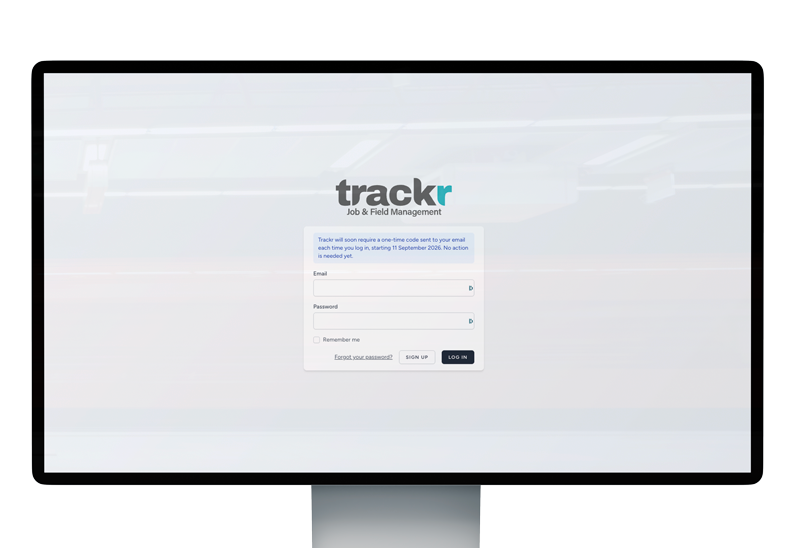
A password alone is one point of failure. Trackr’s login is backed by a one-time verification code sent to your email address on top of your password, so getting into an account takes more than just knowing (or guessing) the password.
What the login flow looks like
Signing in still starts the way it always would — email and password. The difference is what happens next: Trackr sends a one-time verification code to that email address, and it has to be entered correctly before the login completes. Knowing the password gets you halfway; without access to the inbox it was sent to, that’s where it stops. It’s a step added to every login, not just ones from an unfamiliar device or location, so there’s no gap in coverage depending on where or how someone’s signing in.
Why this matters for the data agencies hold
Process-serving, repossession and debt-collection agencies work with information that’s genuinely sensitive on both sides — home addresses, vehicle and asset details, financial circumstances, and details tied to a live legal or enforcement action. A password on its own is one point of failure standing between that data and anyone who guesses it, phishes it, or finds it reused from another breach — and reused passwords are common enough that a breach at some unrelated site can end up being the way someone gets into an account here. A one-time code doesn’t make a guessed password harmless, but it does mean a guessed or leaked password alone isn’t enough to get in.
Covering both the office and the field
Trackr is used two ways day to day — the web app for staff working jobs and clients from a desk, and the native iOS and Android apps field agents carry with them. All of them check in against the same account system, so the same one-time-code step applies whichever way someone’s signing in, on whichever device. That matters in practice because field agents are often signing in from personal or shared devices out on the road, not a managed office computer with its own layer of protection — the login itself needs to hold up on its own, regardless of what device it’s coming from.
Part of a broader access model
Login security is only one layer. Once someone is in, agency data isolation scopes every query to their own agency at the database level, so a compromised login at one agency doesn’t expose another’s data. And Trackr’s own support team can’t view your jobs, clients or financials — or log in as one of your users — without your agency explicitly granting time-limited access first. Secure login is the first checkpoint; it isn’t the only one standing between your agency’s data and the wrong hands.