
Job types
Process-serving, repossession, debt collection and investigation jobs each have their own workflow.
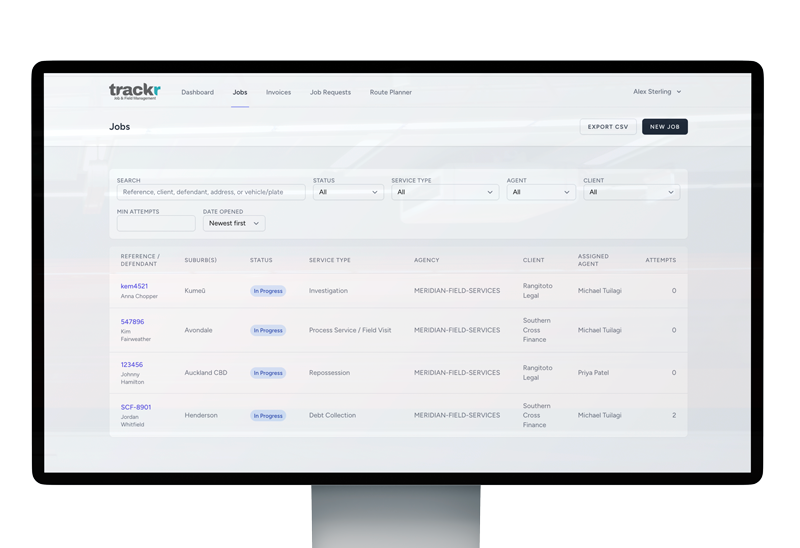

Most job-tracking software treats every job the same: a title, a status, a notes field. Trackr doesn’t, because a repossession isn’t a process-serving job with a different label — it needs a completely different set of information captured in the field.
Create a repossession job and the field agent logs a full vehicle condition report: odometer reading, WOF and rego expiry, tyre and upholstery condition, panel and paint damage, what was actually in the car when it was recovered. Create a debt-collection job and it runs through a proper financial assessment instead — the debtor’s contact details, employer, known assets, and an honest read on their ability to pay, captured at the point of contact rather than reconstructed from memory back at the office. Process-serving and investigation jobs stay lean, logged the same way as any other job with attempts and notes.
Every job type sits in the same system, assigned the same way, invoiced the same way — the difference is only in what gets captured once an agent is actually standing in front of the job.
Why one generic job record doesn’t work across these industries
A process-serving job, a repossession, a debt collection assessment and an investigation don’t share much in common beyond both involving a field agent going somewhere. Forcing all four into the same generic “job” record with a notes field means either the notes field carries all the real information in unstructured text, or the agency ends up tracking the industry-specific detail somewhere outside the system entirely — a separate spreadsheet for vehicle condition, a paper form for financial assessments. Trackr’s job types exist so the structured fields match the work, not the other way round.
What a field agent actually fills in
The difference shows up the moment an agent opens the job on their phone. A repossession job prompts for the specific fields a vehicle recovery needs — odometer, WOF and rego status, condition of tyres, upholstery and panels, and what was actually in the car. A debt collection job prompts for a financial assessment instead — the debtor’s contact and employer details, known assets, and an honest read on ability to pay, captured while the agent is standing in front of the person rather than reconstructed from memory afterwards. Process-serving and investigation jobs stay closer to a straightforward attempt-and-notes format, because that’s genuinely all those job types need.
Why capturing it in the field beats reconstructing it later
A vehicle condition noted from memory back at the office, hours after the recovery, is a weaker record than one logged with the vehicle still in front of the agent — and the same is true of a financial assessment written up after a conversation has already faded. Structuring the fields around the job type is what makes it realistic to capture that detail in the moment instead of relying on an agent’s memory or a follow-up call.
Still one system underneath
None of this splits Trackr into separate tools per job type. Every job — whatever type it is — gets assigned the same way, shows up in the same reporting, and gets invoiced the same way. The job type only changes what gets captured once an agent is actually on site; everything built around jobs generally, from licence-checked assignment to invoicing, works the same regardless of which type the job is.