
Locked down support access
Trackr’s own support team can’t view your jobs, clients or financials, and can’t log in as one of your users, without someone at your agency explicitly granting time-limited access — capped at an hour, revocable any time, and logged in your own Agency Settings.
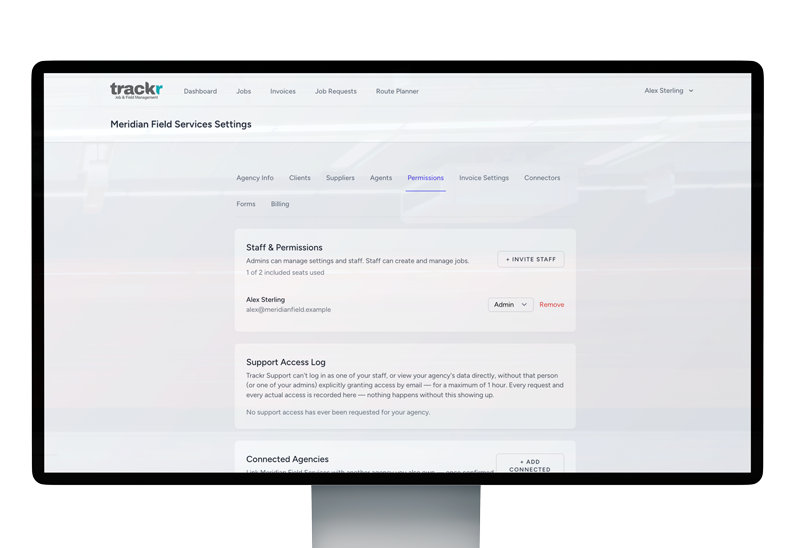

A lot of software vendors can technically look at your data whenever they want — it’s just a matter of policy, not a technical limit. Trackr’s support access is built the other way around: our own support team can’t view your jobs, clients or financials, and can’t log in as one of your users, without someone at your agency explicitly granting access first.
When access is granted, it’s time-limited to a capped window (an hour), revocable by your agency at any time, and fully logged in your own Agency Settings — so it’s a real record, not just a promise in a privacy policy.
Why “we could technically see it” isn’t good enough
A lot of SaaS vendors are honest that their support staff can access customer data — it’s just framed as a policy commitment, not a technical limit. For agencies handling process-serving, repossession or debt-collection work, that distinction matters: the data involved is home addresses, financial circumstances, vehicle details and, often, information tied to a court order. Trusting a vendor’s privacy policy to be the only thing standing between that data and their support team is a weaker position than most agencies would choose if they thought about it directly.
What “explicitly granting access” looks like
By default, nobody on Trackr’s support team can view your jobs, clients or financials, or log in as one of your users. If your agency does need help troubleshooting something, someone at your agency grants access from your own Agency Settings, and that’s what opens the door — not a support ticket alone, and not an internal override on Trackr’s side.
Time-limited and logged, not just switched on
Once granted, access is capped to a limited window — an hour — rather than staying open indefinitely once someone remembers to turn it off. It can be revoked from your side at any time before that window closes, and the grant itself is logged in your Agency Settings, so there’s an actual record of when access was given and by whom, not just a setting that quietly reverts a policy back to normal.
Why this fits agencies handling sensitive work
For agencies whose clients or referrers ask pointed questions about data handling — the same clients who care where the servers physically are — being able to say support access is opt-in, time-boxed and logged is a concrete answer rather than a policy statement to take on faith. It sits alongside NZ-based hosting as one more thing an agency can point to when a client’s own compliance requirements are the reason they’re asking in the first place.